


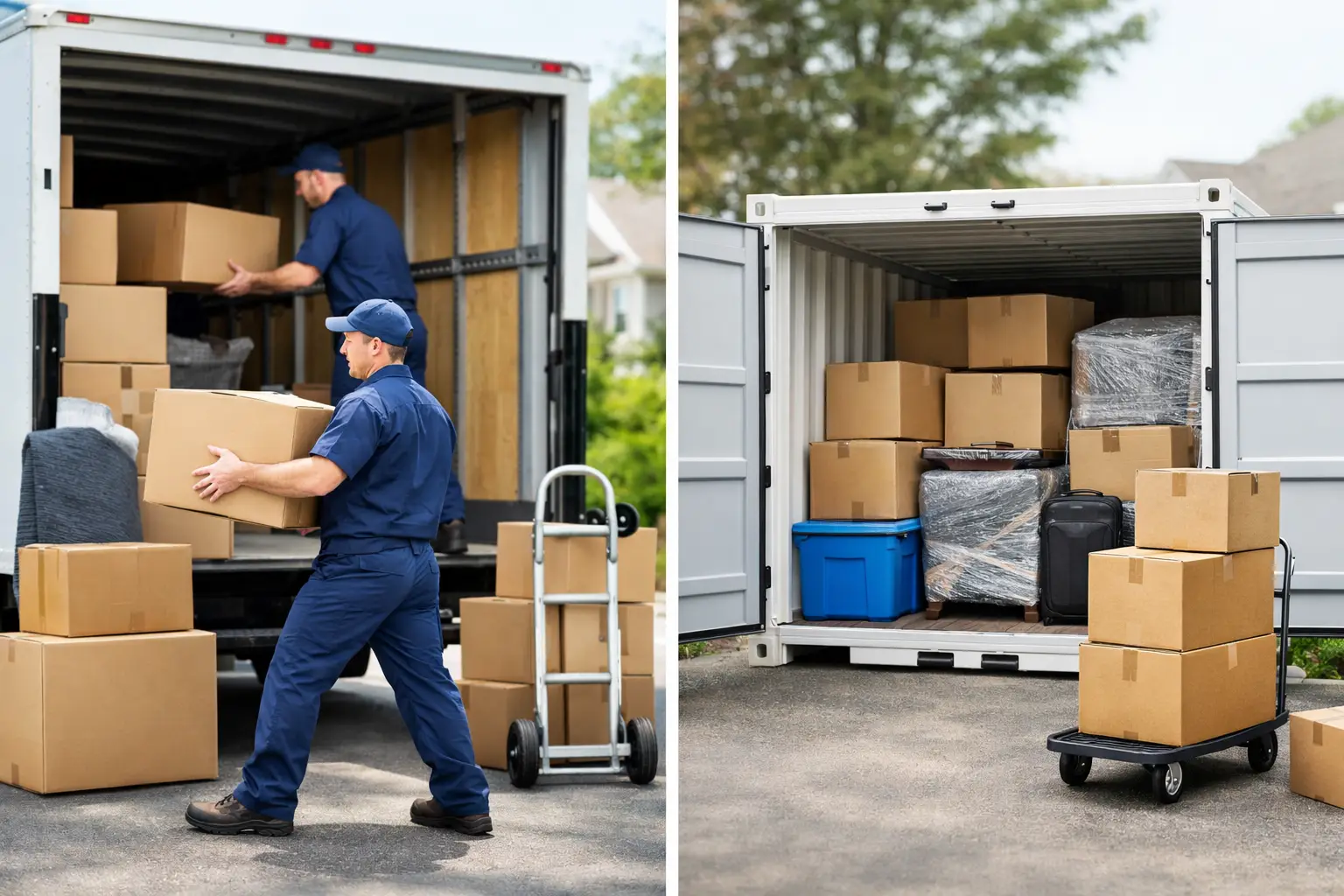
A move can look simple on a quote sheet and become complicated the moment a sofa will not clear the doorway or a closing date changes. When comparing movers versus moving containers, the best choice is not always the lowest advertised price. It is the option that gives you enough control, labor, protection, and scheduling certainty for the move you actually have.
A moving container puts the packing and loading work largely in your hands. A full-service mover provides the truck, trained labor, and coordinated handling from pickup through delivery. Both can be useful, but they solve different problems.
Movers Versus Moving Containers: The Core Difference
With a moving container, a company delivers a portable storage unit to your home. You load it, secure your belongings, and arrange pickup when you are ready. The container is then transported to your destination, where you unload it yourself or hire separate labor. Depending on the provider and location, the container may remain on-site for several days or longer.
With professional movers, a crew loads your belongings into a moving truck, transports them, and unloads them at the new location. You can choose packing services, partial packing, or loading and unloading only, depending on the scope of service. The mover manages the physical work and the transportation plan as one operation.
That distinction matters because transportation is only one part of a move. Packing, lifting, protecting furniture, navigating stairs, parking a truck, and meeting building requirements can take more time and effort than people expect.
When a Moving Container May Make Sense
Moving containers are often a reasonable fit for customers who have a flexible schedule, can handle the labor, and want to load at their own pace. If you are moving from a single-level home with easy access, have help from friends or family, and do not need a fixed delivery date, a container can offer useful flexibility.
Containers can also work well when storage is part of the plan. For example, if your new home will not be ready for several weeks, you may be able to keep the container in storage rather than unloading and reloading your belongings. That can reduce one round of handling.
The trade-off is that flexibility can create more work. You are responsible for organizing the load, using straps and moving blankets correctly, protecting fragile items, and making the best use of the available space. Improper loading can lead to shifting, crushed boxes, scratched furniture, or unused space that costs you money.
Before choosing a container, confirm whether it can be placed legally at both addresses. Some neighborhoods, apartment complexes, homeowner associations, and cities limit where portable containers can sit and how long they may remain there. A container also needs enough clearance for delivery and pickup. Narrow streets, low-hanging branches, steep driveways, and limited curb space can change the plan quickly.
When Hiring Professional Movers Is the Better Fit
Professional movers are usually the stronger choice when time, labor, or access is a concern. This is especially true for families with busy schedules, households with large furniture, people moving from upper-floor apartments, and businesses that cannot afford prolonged downtime.
A trained crew knows how to wrap furniture, protect door frames, carry heavy items safely, and load a truck so the shipment remains stable in transit. That experience is not just about speed. It reduces the chance that a heavy dresser, sectional, or office copier becomes a safety problem halfway through the day.
Hiring movers is also valuable when your move has a firm deadline. If your lease ends Friday, your home sale closes Monday, or your office needs to reopen the next business day, coordinating several separate tasks can be risky. A full-service move keeps loading, transportation, and unloading under one accountable plan.
For a local move, the convenience can be significant. Instead of spending multiple days gathering supplies, recruiting help, loading a container, and unloading at the destination, you can focus on preparing your home and directing the crew. STC Movers can help customers build a service plan around the size of the move, access conditions, and required timeline.
Cost Is More Than the Initial Quote
Moving containers are often viewed as the lower-cost option, but the final cost depends on the details. The base price may not include the supplies, labor, permits, or additional time you need. If you hire loading help at the origin and unloading help at the destination, the gap between a container and a full-service move may narrow.
Professional movers may have a higher upfront quote because labor and equipment are included. However, that quote can be easier to evaluate when it clearly identifies the crew, truck, travel time, packing services, and any special handling required. The value is often strongest when you would otherwise need to rent equipment, buy materials, arrange multiple helpers, or take several days away from work.
Ask either provider what can change the final bill. Common factors include long carries from the truck to the door, flights of stairs, elevators, bulky items, storage time, additional stops, packing materials, and delivery windows. A clear estimate is more useful than a low number that leaves major services undefined.
Consider the Work You Are Actually Taking On
The physical effort of moving is easy to underestimate. A packed three-bedroom home may involve dozens of boxes, appliances, beds, bookcases, outdoor furniture, and items that require disassembly. Loading a container is not simply carrying boxes outside. It requires steady lifting, careful stacking, weight distribution, and enough strength left to unload everything later.
There is also the issue of liability and damage protection. Review each company’s coverage options and understand what applies to your belongings. Professional movers have established procedures for documenting inventory, handling claims, and protecting items during transport. With a container, damage caused by customer packing or loading may be treated differently than damage that occurs while the container is being transported.
If you have antiques, large mirrors, delicate electronics, oversized furniture, or items with emotional value, professional packing and handling may be worth the added cost. The right choice is not about assuming one option is universally safer. It is about deciding who has the tools, training, and time to protect your specific shipment.
Timing and Delivery Can Decide the Choice
A container usually gives you more time to load, but delivery timing may be less immediate than a dedicated local moving truck. For long-distance moves, your belongings may be transported alongside other shipments or moved according to a broader logistics schedule. That is not necessarily a problem, provided your move-in date is flexible and you plan for it.
Full-service movers can be better suited to moves that require a defined pickup and delivery plan. For local relocations, the same crew may load and unload in one day. For longer moves, ask about the delivery window, tracking, communication process, and what happens if dates shift.
Commercial moves need particular attention here. An office may need furniture, files, computers, and equipment moved in a specific sequence so employees can return to work quickly. In that situation, labor coordination and controlled execution often matter more than the lowest transportation price.
Questions to Ask Before You Commit
Ask whether the quote includes labor, transportation, equipment, fuel, materials, and any access-related charges. Confirm the pickup and delivery schedule, cancellation terms, and protection options. If you are considering a container, ask about placement requirements, storage costs, and the exact period you can keep it.
For movers, describe your home or business accurately. Mention stairs, elevators, narrow hallways, large or fragile items, parking restrictions, and every pickup or delivery stop. Good information before move day helps prevent avoidable delays and gives the crew the chance to arrive prepared.
The right move plan should leave you with fewer unknowns, not more. If you have time, strong help, easy access, and a need for temporary storage, a moving container can be practical. If the move involves heavy labor, tight timing, difficult access, valuable items, or business operations, a professional moving team is often the more controlled choice.
Choose the option that protects your schedule and your belongings as carefully as it protects your budget. A well-planned move is not defined by how much work you took on. It is defined by arriving ready to settle in or get back to business.